

[a photo blog about architectural details and urban idiosyncrasies]
Wednesday, August 3, 2011
bougainvillea tunnel in Antalya
Tuesday, August 2, 2011
another set of horseshoe arches, in Lisbon

Monday, August 1, 2011
horseshoe arches in Montreal, Fes, and Cordoba


Saturday, July 30, 2011
yarn bombing in Prague and Boston


Thursday, July 28, 2011
map of the city on a wall in Zurich

Wednesday, July 27, 2011
granite and river rocks in Boston

Tuesday, July 26, 2011
patterned facades in Prague and Budapest


Monday, July 25, 2011
sewer music
There's a feature in the Boston Globe today about a group of phonographers from the New England Phonographers Union (who knew there was such a thing?) recording background noises from the Deer Island sewage treatment plan in order to make music from the ambient sounds. Their aim they say, was to bring these background sounds to the foreground, allowing people to hear these rhythmic processes that are otherwise ignored. "That's exactly why you would go out there to find beauty, because you would never expect to find it there."
Below, a video from the Boston Globe explaining the project:
Below, a video from the Boston Globe explaining the project:
Sunday, July 24, 2011
colorful shadows in Montreal

Late-afternoon sunlight streams through tinted panes of glass in Montreal's Palais de Congrés casting colorful, elongated shadows on the gray stone floor of the building's lobby.

For a short time each afternoon, sunlight hits the building at the just right angle to pass through the colored-glass facade and back out through a transparent glass wall on another side of the building, creating a momentary spectacle of tinted shadows on an adjacent street.

Alternating facades of transparent and tinted glass envelope the Palais de Congrés. Rue de Bleury, Montreal, Quebec.
Friday, July 22, 2011
round, exposed-masonry columns around Boston

This squat column supports the corner of a building on Boston Avenue in Somerville, Massachusetts.

 Three-story brick columns guard the front of the Old Courthouse in Cambridge, Massachusetts.

Round, two-story mortar-stacked stone columns blur into the facade of a building on Vernon Street in Framingham, Massachusetts.
Thursday, July 21, 2011
X marks the spot in Bratislava

This wooden door blocks entry into the courtyard at the Old Town Hall in Bratislava, Slovakia. Notice how the pattern culminates in a four-pointed star right at the point where the three sections of the door come together in this door-within-a-double-door arrangement.

Here are two more patterned doors spotted side-by-side on Országház utca in Budapest, Hungary.
Tuesday, July 19, 2011
another sign in Montreal


Rather than putting a giant sign across the front facade of this slick building, the architect placed the sign for the Rosalind and Morris Goodman Cancer Research Center behind glass, high up on the back wall of a tall conference room at the front of the building, where it won't distract from the clean lines of the building's design. Avenue des Pins, Montreal, Quebec.
Monday, July 18, 2011
trace of the past in Montreal
I'd like to restart this blog with a new feature. From now on I'll be posting photographs that I've taken of details and curiosities, some intended and others unintended, that I find interesting on buildings or in urban environments. My hope is to encourage others to notice the details that give character to the built environments around us. Here's something that caught my eye recently in Montreal:
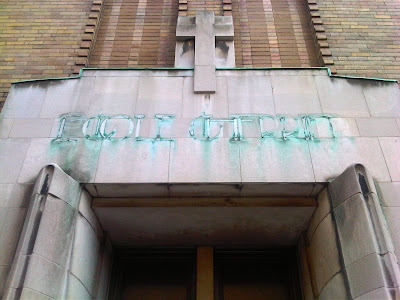
Green stains from long-gone oxidized copper lettering are ghostly evidence of this building's former function as a school, "Ecole Cherrier." Rue Cherrier, corner Saint-Hubert, Montreal, Quebec.
Tuesday, August 10, 2010
A+Pool
A group of architects and designers have put together a plan to set up a series of floating swimming pools in the rivers around Manhattan. Each of these “plus pools” is envisioned as a cruciform body of water the size of two Olympic swimming pools that would float a hundred feet or so off shore at locations like Battery Park City, the Chelsea Piers, and Brooklyn Bridge Park.
 Architect's rendering of a +Pool in the East River
 Rendering of a +Pool floating in the shadow of the Brooklyn Bridge.
Connected to these urban parks by meandering, floating walkways and surrounded on all sides by a wide deck well stocked with lounge chairs, these pools would offer New Yorkers a unique respite with panoramic views of the city’s skyline and bridges. Moreover, the location of the pools in the vast space of New York’s waterways not only affords city residents an unusual opportunity to swim in the city’s urban rivers without risking their health but also allows visitors to immerse themselves in a kind of wide-open space that is exceptionally rare in New York’s concrete jungle. And, in addition to lending itself to catchy marketing strategies, the iconic shape of the +Pool is designed to create distinct spaces that cater to the different groups of people who might use the pool – one section for sports and games, one for swimming laps, one for little kids, and another section just for lounging – all of which are joined at the center of the pool to enable reconfigurations for alternate types of recreation.
 A +Pool swimmer on the East River
 The flexible spatial configuration of the +Pool
Another more symbolic significance of the pools’ “plus” shape is described on the project’s website: “An offshore reflection of the city intersection, +Pool both exemplifies the dense, busy character of New York City and offers an island retreat from it.”
 Urban street intersection as the inspiration for the +Pool's cruciform shape
Anticipating that the plus pools would likely strike some New Yorkers as a crazy, perhaps impossible endeavor, the project’s organizers have been careful to cite the substantial historical precedence for this kind of floating recreation facility. On the +Pool website, they describe the floating spas that once crowded Manhattan’s shores beginning in the early 1800s when the city’s elite started to use lower Manhattan as a resort. In later decades of the same century, newly arrived immigrants used Manhattan’s riverside bathhouses as their regular bathing facilities. The project’s coordinators also make mention of a similar floating pool that was built in 2007, though on a much smaller scale, from an old barge in the Bronx, a project that they credit as having “brought back the first semblance of New York’s floating pool culture in almost a century.”
 Architect's rendering of a +Pool in the East River
 Rendering of a +Pool floating in the shadow of the Brooklyn Bridge.
Connected to these urban parks by meandering, floating walkways and surrounded on all sides by a wide deck well stocked with lounge chairs, these pools would offer New Yorkers a unique respite with panoramic views of the city’s skyline and bridges. Moreover, the location of the pools in the vast space of New York’s waterways not only affords city residents an unusual opportunity to swim in the city’s urban rivers without risking their health but also allows visitors to immerse themselves in a kind of wide-open space that is exceptionally rare in New York’s concrete jungle. And, in addition to lending itself to catchy marketing strategies, the iconic shape of the +Pool is designed to create distinct spaces that cater to the different groups of people who might use the pool – one section for sports and games, one for swimming laps, one for little kids, and another section just for lounging – all of which are joined at the center of the pool to enable reconfigurations for alternate types of recreation.
 A +Pool swimmer on the East River
  The flexible spatial configuration of the +Pool
Another more symbolic significance of the pools’ “plus” shape is described on the project’s website: “An offshore reflection of the city intersection, +Pool both exemplifies the dense, busy character of New York City and offers an island retreat from it.”
 Urban street intersection as the inspiration for the +Pool's cruciform shape
Anticipating that the plus pools would likely strike some New Yorkers as a crazy, perhaps impossible endeavor, the project’s organizers have been careful to cite the substantial historical precedence for this kind of floating recreation facility. On the +Pool website, they describe the floating spas that once crowded Manhattan’s shores beginning in the early 1800s when the city’s elite started to use lower Manhattan as a resort. In later decades of the same century, newly arrived immigrants used Manhattan’s riverside bathhouses as their regular bathing facilities. The project’s coordinators also make mention of a similar floating pool that was built in 2007, though on a much smaller scale, from an old barge in the Bronx, a project that they credit as having “brought back the first semblance of New York’s floating pool culture in almost a century.”
Subscribe to:
Posts (Atom)